
September 2, 2026 - PBS News Hour full episode
9/2/2026 | 57m 46sVideo has Closed Captions
September 2, 2026 - PBS News Hour full episode
September 2, 2026 - PBS News Hour full episode
Problems playing video? | Closed Captioning Feedback
Problems playing video? | Closed Captioning Feedback
Major corporate funding for the PBS News Hour is provided by BDO, BNSF, Consumer Cellular, American Cruise Lines, and Raymond James. Funding for the PBS NewsHour Weekend is provided by...
September 2, 2026 - PBS News Hour full episode
9/2/2026 | 57m 46sVideo has Closed Captions
September 2, 2026 - PBS News Hour full episode
Problems playing video? | Closed Captioning Feedback
Where to Watch PBS News Hour
PBS News Hour is available to stream on pbs.org and the PBS app.
Providing Support for PBS.org
Learn Moreabout PBS online sponsorshipGEOFF BENNETT: Good evening.
I'm Geoff Bennett.
AMNA NAWAZ: And I'm Amna Nawaz.
On the "NewsHour" tonight: Iran launches more strikes in retaliation for U.S.
attacks, including what Iran claims was a bomb that hit a wedding.
GEOFF BENNETT: We speak with the attorney for a whistle-blower who alleges the U.S.
Postal Service is rushing a mail ballot system that could affect millions of midterm votes.
DAVID KLIGERMAN, Attorney For USPS Whistle-Blower: The biggest unanswered question is, what -- by what measure do they actually believe this system's going to work?
And what are Americans supposed to do if and when it crashes?
AMNA NAWAZ: And Trump administration officials cast doubt on the role measles played in two deaths in Pennsylvania, sparking another political debate over public health.
(BREAK) AMNA NAWAZ: Welcome to the "News Hour."
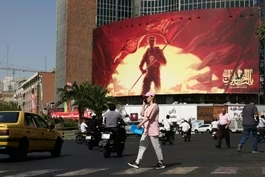
Iran attacked U.S.
bases and allies in the Persian Gulf region early today, following American attacks along Iran's southern coast overnight.
It was the largest exchange of fire between the U.S.
and Iran since July.
Iran's health minister said U.S.
attacks killed at least 18 people and injured over 100.
GEOFF BENNETT: Meantime, at the White House today, President Trump said this renewed campaign wouldn't last long, but threatened to hit Tehran, as he put it, very hard if the conflict over the Strait of Hormuz remains unresolved.
Our White House correspondent, Liz Landers, starts our coverage.
LIZ LANDERS: Last night and into today, U.S.
missiles slammed into Iran's southern coast, this time Iranian officials saying one of the strikes hit a home in a town overlooking the Strait of Hormuz, killing at least four people, including two children, what was earlier in the night a lively wedding celebration now a grim reminder of America's war with Iran.
Local officials said at least 68 people were wounded, with some being treated at a hospital.
The father of the bride said his home was destroyed.
ALI MALLAHI, Father of the Bride (through translator): It was a very distressing incident.
And right now I'm extremely worried and upset about it.
And I truly do not know what to do.
LIZ LANDERS: In a statement to PBS News, a spokesperson for U.S.
Central Command said -- quote -- "We're aware of the reports which originated from Iranian state media, and we are looking into them.
The U.S.
military never targets civilians, unlike the IRGC."
A regional source told PBS News that the U.S.
military was targeting and hit a communications tower in the neighborhood where the wedding was held.
The strike was a part of a barrage of attacks by the U.S.
against what it says were Iranian military targets in response to Iran's attempt to attack commercial ships and American forces in the region.
Meanwhile, regional American allies last night again on the receiving end of Iran's retaliation.
In Kuwait and in Jordan, night skies were illuminated by Iranian drones and missiles that were intercepted as they attempted to target U.S.
bases in the region.
And on the Strait of Hormuz, the U.S.
military struck two Iranian government tankers and nearly 100 military targets under a new tanker-for-tanker policy that sources say was approved by the president, according to reporting from Axios.
This marks the first time the U.S.
has struck Iranian tankers in retaliation for Iranian attacks on ships in the strait.
Today, in the Oval Office, President Trump claimed the strait is under U.S.
control, warning the strikes are the first of many.
DONALD TRUMP, President of the United States: We're taking out a lot of ships.
They can't see it because they have no radar, because we blew it up, and we blew up much more than their radar last night.
It was a very heavy attack.
LIZ LANDERS: The fierce exchange of fire not only shattered a month-long lull in the war, but also sent oil prices climbing yet again and triggered instant shockwaves across global markets.
And on FOX News today, Treasury Secretary Scott Bessent said U.S.
sanctions will asphyxiate the Iranian regime.
SCOTT BESSENT, U.S.
Treasury Secretary: It is a powerful combination.
We had the six weeks of successful kinetic strikes.
Then we have imposed the blockade.
LIZ LANDERS: This comes as Bessent said 19 of the G20 finance ministers agreed that ongoing streams of Chinese exports are unsustainable, though China dissented from the consensus.
Bessent made his comments yesterday at the end of a two-day meeting with finance ministers and central bankers in North Carolina.
For the first time since they invaded Ukraine, Russia was invited by the United States to the ministerial meeting.
And though Russia is being squeezed economically by sanctions, reports indicate that Bessent told Russia there would be no U.S.
economic cooperation with that country until the Ukraine war ends.
For the PBS "News Hour," I'm Liz Landers.
GEOFF BENNETT: For perspective now on the latest flare-up in the war with Iran and the impact on the global economy, we turn now to Cliff Kupchan, chairman emeritus at the consulting firm Eurasia Group and senior fellow at the think tank Center for the National Interest.
Thanks for being with us.
CLIFF KUPCHAN, Chairman Emeritus, Eurasia Group: Thanks.
GEOFF BENNETT: So, what has the war with Iran meant for the global economy so far?
CLIFF KUPCHAN: It has meant and it continues to be a major irritation, a major dent.
I mean, certainly, this war is not going to end any time soon.
High energy prices, not just oil and LNG, but also refined product, which is worse than oil right now, stoke inflation.
And you have got this natural body of water that is a choke point for just so much of the global economy for oil, LNG, refined product, or for high tech, fertilizer.
Just a lot of things we use every day goes through the strait.
And it's going to be a very risky proposition getting stuff out of there for a long time.
GEOFF BENNETT: And oil prices have certainly risen, not nearly as much as some analysts initially expected.
Why has the impact been more limited than feared?
CLIFF KUPCHAN: Right.
Well, most analysts indeed thought we'd see $130, $140, $150, and we haven't.
We got up to about $120, and that was short and didn't last long.
So it hasn't been as bad as it could have been, for a couple of reasons.
First, more oil is getting out than I thought would get out, than most people thought would get out, about 800 million barrels a day last week from the strait itself, and 12 million barrels a day if you include the backup pipelines to the UAE and through Saudi; 12 million barrels a day is about 65 percent of prewar crude volumes, and that's a lot of oil.
Now, also China was not buying through the war so far, has picked up a little recently, but generally has not bought as much as it did previously for Strategic Petroleum Reserves.
And, finally, both China and the U.S.
are letting oil out of their reserves in an attempt to keep prices down.
So there's been effective management.
Now, pressure will eventually build, and the crude price will go up.
It's in the $90s right now, and diesel and product prices will go up even further and provide even more of a headache for the president.
So there's a respite, but it's not an easy one.
It's not a long one.
GEOFF BENNETT: Well, how much of the current pressure on the global economy can be traced to the war, and how much can be traced to President Trump's trade policies?
CLIFF KUPCHAN: I think the trade policy -- we're past peak tariff, I think past the peak use of the tariff weapon.
And now I don't think a lot of what we're seeing right now, or most of what we're seeing right now is a first-order effect of the tariffs.
I think more of it -- more of it is the war.
That's what's really changed since February.
But the economy in this country is not doing all that badly going on in parallel with an unprecedented technology boom, unprecedented A.I.
boom, all sorts of investment going in.
So I think most of it is the war, but it's not as bad as it could have been, and we have got a whole lot of boom going on in the town I'm in right now, New York.
GEOFF BENNETT: What should we be watching for that would suggest that the economic consequences of both the war and the tariff policies are becoming more significantly serious?
CLIFF KUPCHAN: Tariff policy I think is a one-trick pony.
Either we sanction major Chinese refineries or we don't in this country.
And I don't think that the U.S.
is about to do that, upset the coming summit, upset U.S.-China relations, which the president really cares about.
So I think, on sanctions, that's the main thing to watch.
On the war, how long does this last?
The sort of no war, no peace is not tenable.
As I said before, price pressure will build over time from crude.
Price pressure will build over refined product.
This is a dike that the president can't hold on to forever.
Leaks will happen.
So I think, with time, I think with time, we're going to see an upward pressure on prices, and that's what we should watch for.
GEOFF BENNETT: In the time that remains, I want to ask you about Russia, because the Treasury secretary, Scott Bessent, he met with his Russian counterpart at the G20... CLIFF KUPCHAN: Yes.
GEOFF BENNETT: ... and reportedly said there'd be no economic relief for Russia, there'd be no agreement on any other issue until the war with Ukraine ends.
What did you make of that meeting?
CLIFF KUPCHAN: I think the administration and Secretary Bessent got it right today.
I think it's time to start some sort of meeting with the Russians.
They're a major power.
They are economic players, but, at the same time, make it clear that nothing will be normal about the relationship until the war is over.
So I give them credit for a good foray into diplomacy of the G20 in Asheville.
GEOFF BENNETT: Cliff Kupchan, thank you again for joining us this evening.
We appreciate it.
CLIFF KUPCHAN: My pleasure.
Thank you.
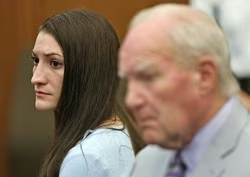
AMNA NAWAZ: In the day's other headlines: The jury in Lindsay Clancy's murder trial remains deadlocked, telling the judge for the second time in as many days they have been unable to reach a verdict.
JUDGE WILLIAM SULLIVAN, Massachusetts Superior Court: "After much deliberation, we are still unable to come to a unanimous decision."
Now, based on that, I'm going to give you another instruction.
AMNA NAWAZ: Judge William Sullivan urged the jurors to break the impasse on their fifth day of deliberations.
The jury is deciding whether to hold Clancy criminally responsible for killing her three children in 2023.
Her attorney argues that postpartum psychosis led to her actions.
Prosecutors say Clancy knew what she was doing was wrong.
Deliberations are set to resume tomorrow morning.
Tiger Woods will have his driver's license suspended for five years as part of a plea deal related to a car crash near his Florida home earlier this year.
The 50-year-old golfer appeared in a Florida court this morning to plead no contest to reckless driving.
He was also fined $1,500.
Woods was arrested in March after officers found pain pills in his pocket and said he showed signs of impairment after his vehicle clipped a truck and rolled over.
He had initially pleaded not guilty to driving under the influence.
Neither Woods nor the other driver were injured.
Tropical depression Edouard brought more torrential downpours to Texas today as it moved north into the state.
Cities like Beaumont on the border with Louisiana remained under flood alerts after seeing up to 21 inches of rain.
Areas around Houston saw streets turned into rivers.
Schools in affected areas were canceled and government offices closed.
Edouard made landfall yesterday as a 60 mile-an-hour tropical storm before weakening.
Meantime, it continues to be unseasonably hot for much of the eastern half of the country, with more than 90 million people under some form of heat alert.
Officials from the U.S.
and Venezuela signed a series of deals today to develop the country's oil reserves.
On a visit to Caracas, U.S.
Energy Secretary Chris Wright called it an historic day in the transformation of Venezuela.
CHRIS WRIGHT, U.S.
Energy Secretary: If we can replace the conflict of the past with commerce of today and of the future, we can build a better world.
AMNA NAWAZ: Earlier this week, the Trump administration announced a framework agreement that would allow the U.S.
access to around one-fifth of the country's oil reserves.
The Pentagon will get a stake in the revenues.
U.S.
oil giant Chevron is among those looking to benefit.
It's committing $7 billion to double its production over the next five years.
But, on the ground, some Venezuelans remain doubtful.
GUSTAVO LOSSADA, Small Business Owner (through translator): I don't see any benefit for the people because the U.S.
is going to take the oil, and then what?
We lose power for six or seven hours?
So where's the benefit for the people?
It should be so that we're better off.
AMNA NAWAZ: Industry analysts have also expressed skepticism towards processing Venezuela's crude, which is notoriously difficult to refine.
Still, the White House says Venezuela's oil could enter U.S.
reserves as soon as November.
In Nepal, mourners held symbolic funerals today for those lost in last week's devastating floods, which officials say killed at least 1,100 people.
RAM NARAYAN SHARMA, Lost Family in Nepal Floods (through translator): We lost six members of my family to the floods.
We are performing these rituals so that their souls can attain peace.
AMNA NAWAZ: More than a week after the disaster struck, more than 3,900 people remain missing, and hopes are fading of finding survivors.
The floods also struck China's side of the border, where state TV is reporting that at least 21 people are now confirmed to have died.
More than 540 others remain unaccounted for.
The U.S.
Mint started selling $1 coins today, featuring President Trump's image.
The coins are meant to commemorate the nation's 250th anniversary and cost as much as $2.44 each.
Officials say the coins can be used as legal tender.
But their usage and legality have been questioned because federal law bars the depiction of living presidents on the nation's currency.
Also, Apple is the latest tech company to change Lake Ontario to Lake America for U.S.
users of its map services.
The update comes days after President Trump ordered a new name for the body of water as part of his ongoing trade war with Canada.
Google Maps made a similar change this past weekend.
So far, MapQuest has said it's not changing the name.
Apple's decision today won't necessarily affect users outside the U.S.
A federal judge ruled today that Google does not have to break up its advertising technology business.
Instead, the tech giant was ordered to change its practices to address monopoly concerns.
It's a major win for Google and just the latest example of the company fending off antitrust challenges.
Shares of parent company Alphabet ended the day half-a-percent higher.
Elsewhere on Wall Street today, stocks rebounded after a sluggish start to the week.
The Dow Jones industrial average gained nearly 300 points.
The Nasdaq rose almost half-a-percent.
The S&P 500 also ended in positive territory.
And jazz singer and songwriter Cassandra Wilson has died.
With unique takes on songs like "Harvest Moon," Wilson was one of the major jazz acts of the 1980s and '90s.
She won two Grammys, and in 2001, "TIME" magazine declared her America's best singer.
With a distinctive voice and cross-genre appeal, she opened for the likes of Miles Davis and also covered artists like Joni Mitchell and Cyndi Lauper.
Cassandra Wilson died today in her native Mississippi.
She was 70 years old.
Still to come on the "News Hour": 80-year-old Senator Ed Markey wins the Massachusetts Democratic primary, highlighting the party's generational divide; Trump administration officials sow doubt about recent measles-associated deaths; and painter Alex Katz reflects on his career and body of work as he approaches his 100th birthday.
GEOFF BENNETT: Last night, we reported on allegations from a whistle-blower inside the U.S.
Postal Service who says the agency is rushing to implement a new system for handling election mail that has not been adequately tested and could put mail-in ballots at risk.
Tonight, we're taking a closer look at those allegations, the evidence behind them, and what the recourse may be.
The whistle-blower is remaining anonymous, but is represented by the organization Whistleblower Aid.
And joining us now is David Kligerman, senior vice president and special counsel for Whistleblower Aid.
Thank you for joining us.
DAVID KLIGERMAN, Attorney For USPS Whistle-Blower: It's a pleasure to be here.
GEOFF BENNETT: Without revealing details about your client, explain why you're confident this person was senior enough or close enough to the decision-making to actually know what was happening.
DAVID KLIGERMAN: Sure.
This individual was close enough to decision-making because, first and foremost, of the information that they were able to represent to us that we understood how it worked.
This individual was in a system with enough knowledge to see across a system.
And this -- and we're confident that if one would reach out to the Postal Service, they'd be able to identify material documents that would verify these things that the whistle-blower had brought forward.
GEOFF BENNETT: And what was the process by which this whistle-blower decided to come forward?
DAVID KLIGERMAN: Sure.
It's an interesting one, actually.
This individual had -- was watching a show about democratic governance and good governance and had been concerned about what they were seeing at work and as a result reached out to the show's producers, and through a number of individual connections finally found their way to us.
And it was really quite fortunate that this individual did, because it's not always a clear path to find folks to help you do this.
It's not every day that someone comes forward to blow the whistle on a major government scandal.
GEOFF BENNETT: And at the heart of this disclosure is the claim that the Postal Service is moving ahead with this new system for handling election mail that hasn't been adequately tested.
How could those problems translate into ballots being delayed, mishandled, or not counted at all?
DAVID KLIGERMAN: Sure.
There are really sort of two problems.
One is a information technology problem, and one's a systemic problem.
I'll talk about the latter, which is, the latter is that you've -- they've built through this rule, they've developed a system that has a number of checks, and at each process part of the check, they have a zero percent failure requirement, which means that, if any one little mistake is made, even if the I.T.
is working perfectly, if you enter your information and it checks one list against another, one against another, you finally go to the post office with a huge card of ballots, 1,000, 10,000 -- Maricopa County, there's examples of a million.
You go in and if they scan a certain number of ballots, and any one is an error, they all go back, right?
And that's with an I.T.
system that's working properly.
Now, imagine when you hear that -- imagine what the concern would be, like our whistle-blower had, when you know the system is not built at all or it's not built well?
So you've got a system that should take a year, maybe two years to develop.
It was done in eight weeks, and that -- if you back out the four weeks where they stopped work, about four or five weeks.
And this is a system that's very complicated.
It has a number of systems having to talk to one another, and they didn't test it properly.
They didn't build it properly.
They didn't they didn't integrate it properly and test it as a unit.
And when they do test it, it fails.
And so this individual is rightly concerned, as are a number of Americans.
GEOFF BENNETT: Your client also alleges that the Postal Service continued working on this system despite a federal court order to stop.
USPS said in a statement in part: "This work has at all times been conducted in a manner consistent with court orders.
Importantly, in an order issued by the U.S.
district court this week, the court expressly confirmed that the Postal Service may continue its work to establish the portal and communicate with states regarding design standards on a voluntary basis."
So what specifically do you believe the Postal Service did that violated the court's order?
DAVID KLIGERMAN: So there are two sets of court orders.
The Postal Service responding to the latest one, but there was an earlier injunction, right?
And during that earlier injunction, the Postal Service itself said, wait a second, we're doing is in violation of it, or at least believe, so they stopped work.
But then, in the middle of that injunction, nothing had changed.
Our client had gone to other senior officials and said, hey, what's changed?
And no one would answer.
But, nevertheless, work resumed, right?
So work resumes under a court order where they thought it had to stop.
And now, under this -- in this scenario, they're saying, oh, there's nothing to see here.
We're just building the system.
But why the rush?
Every step of the way, they push, push, push towards this date for this election.
If they're just building a system for some future election, which is what the order excludes, fine, but that's not what's happening here.
They rushed it out to the September date.
They have now put notice out that states can play with it and experiment with it, to use it to get familiar with it.
The intent is clearly for this election, and that's what's in violation.
GEOFF BENNETT: What's the single most important unanswered question that the U.S.
Postal Service could resolve in this case?
DAVID KLIGERMAN: Sure.
I think the most -- I think the biggest unanswered question is, what -- by what measure do they actually believe this system is going to work?
And what are Americans supposed to do if and when it crashes?
GEOFF BENNETT: If the normal oversight mechanisms, Congress, the White House, the Postal Service itself, don't act on these allegations, what recourse is there?
Are the courts the -- an appropriate remedy?
DAVID KLIGERMAN: I think unfortunately the courts may be the only remedy.
And I know the case is winding its way through the courts.
There's an injunction that's a 14-day injunction.
It was entered into on the 27th, so it expires at some point next week or right after.
And what happens?
One hopes that there's another injunction put in place while the court's looking more closely at it, but it's going to go up and appeal to the Supreme Court.
And if the Supreme Court decides to hear it, they're going to have to look at this.
And there are two arguments.
One is that it's patently unconstitutional because this exceeds the authority of the executive branch.
But there's another argument, which I think this disclosure boosts, which is, regardless of that, it's being done in a way which violates administrative law, that it's not a system that is appropriate to be released, there wasn't enough preparation for it, and therefore it's of -- the harm to the states is such that they shouldn't have to use it.
GEOFF BENNETT: David Kligerman with Whistleblower Aid, thanks again for joining us this evening.
DAVID KLIGERMAN: My pleasure.
Thanks for having me.
AMNA NAWAZ: Democratic voters in Massachusetts bucked a national trend last night, voting to back incumbent Democrats in Congress.
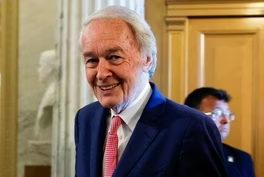
Incumbent Senator Ed Markey held onto his spot on the ballot, staving off a primary challenge from Congressman Seth Moulton in a race that frequently focused on age and the party's direction.
It wasn't just the Senate race.
House incumbents Richard Neal, Stephen Lynch, and Dan Koh all beat their own challengers last night.
The results skew from a national narrative Democrats have faced all year, that their voters are eager for new, younger leadership.
Joining me now to break down what all this means is Democratic strategist and pollster Terrance Woodbury.
His work focuses mostly on young and minority voters.
Terrance, welcome to the "News Hour."
Thanks for joining us.
TERRANCE WOODBURY, Democratic Pollster and Strategist: Thank you so much for having me.
Glad to be here.
AMNA NAWAZ: All right, let's start with the news out of Massachusetts.
You had 80-year-old Senator Markey there fending off a challenge from 47-year-old Seth Moulton.
Markey has been in Congress longer than Moulton has been alive.
And as we noted, Democratic voters keep saying they want change.
So how did Markey win?
TERRANCE WOODBURY: A lot of the analysis has been focused on the identity and the ideology of the candidates, rather than the frustration and appetite of the electorate, right?
And so when we look at the electorate that Ed Markey won with, Ed Markey won overwhelmingly.
I mean, he won everybody everywhere, 65 percent of the -- almost 65 percent of the vote.
But he won, he did significantly better amongst -- in precincts that had a larger Black or Hispanic population.
I don't think that this has been that this primary has taught us that Democratic voters are looking for young versus old or moderate versus progressive, but that they're looking for do something versus do nothing.
And Ed Markey ran on a record of what he has done, not just the promise of what he will do, and he was rewarded for that.
AMNA NAWAZ: Terrance, I know you have undertaken a yearlong project of polling and focus groups looking closely at the Black political engagement in this country.
Black voters, of course, traditionally are -- represent the strongest support base for Democrats.
But, according to exit polls, when you look over recent years, Democratic presidential candidates have now seen a nine-point drop in support from Black voters between 2008 and today, an 18-point drop from Black men specifically over that same time period.
You said recently that Black voters are increasingly turning into swing voters.
Tell me more about that.
Why?
TERRANCE WOODBURY: Yes, we have seen this in the Trump era, that there's a new swing voter that's been determining the outcome of these elections, that the conventional swing voter that we have often looked to, suburban women, white women, soccer moms, Joe the Plumber, all of these kind of monikers of the conventional swing voter, when in fact it is now men of color and youth of color that are swinging the most back and forth.
A lot of what is contributing to that is what I would call the Trump-curious voters, that there were men of color who were frustrated with both parties.
They're not swinging because they're bipartisan.
In fact, they're swinging because they're anti-partisan.
They hate both parties.
They feel like they have been failed by both parties.
And so some of those Trump-curious voters who gave him a shot in 2024, not because they liked him -- they didn't have a very high favorability of him, but they were willing to try something different, and specifically willing to try the candidate that was offering to blow up and disrupt the systems that had failed them.
AMNA NAWAZ: You have spoken previously about the need for candidates to speak to the most politically disengaged and cynical voters.
When you're looking at those who are now identified in your work as swing voters, you're looking at the Black voting base, what is your work in polling tell you about what is driving them to the polls?
What is the animating issue for these upcoming elections?
TERRANCE WOODBURY: We have seen a remarkable shift that happened right around the Callais decision, the Callais Supreme Court decision that gutted the Voting Rights Act.
And that is, when Black voters feel their power, feel their votes or their well-being under attack, that they respond in kind in what I have called a blacklash.
AMNA NAWAZ: I should just note the Callais decision allowed Louisiana, new congressional district maps to move ahead.
TERRANCE WOODBURY: Yes, exactly, the Callais Supreme Court decision that gutted the what was left of the Supreme Court -- I'm sorry -- of the Voting Rights Act.
And I have often described the South as not -- the South are not red states.
They have been oppressed states.
And that Callais decision really put that oppression front and center for Black voters.
And since then, we have seen the level of engagement increase.
But, most important, we saw a surge in Black turnout.
AMNA NAWAZ: Terrance, briefly before I let you go, we know that no voting bloc is a monolith, right?
And you see generational divides you have looked at more closely as well.
Tell me about those.
TERRANCE WOODBURY: What we have seen more recently is that the real gap is not the gender gap in politics.
It is a generation gap.
It is that young people are beginning to respond and show up and participate in politics very differently.
You know, this is what we call walk and chew gum.
We are going to have to address the kitchen table issues that's preventing these young people from realizing the American dream -- the American dream, while also addressing these identity issues that are defining many - - much of their political reality.
AMNA NAWAZ: All right, that is Democratic strategist and pollster Terrance Woodbury joining us tonight.
Terrance, thank you so much.
Good to speak with you.
TERRANCE WOODBURY: Thanks for having me.
GEOFF BENNETT: It's been nearly five years since the Taliban banned education for all girls older than 12 in Afghanistan.
And they didn't stop there.
Now every day seems to bring a new law limiting women.
But Afghan women are pushing back.
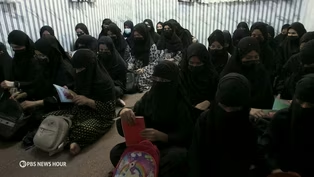
AMNA NAWAZ: In this exclusive report, special correspondent Leila Molana-Allen and videographer Eric O'Connor visit a secret underground school in the capital city of Kabul, and they were the first international news crew to sit down with the women risking their lives to protest the oppressive rules.
And a note: The identities of all the women have been changed for their protection.
LEILA MOLANA-ALLEN: Each morning, in the early dawn light, dozens of teenage girls pass quietly through an unmarked door that stands open on an unremarkable side street.
They climb down a darkened stairway, descending to a stiflingly hot basement hidden behind thick curtains.
They're not allowed to be here.
But, in today's Afghanistan, the list of what women and girls are allowed to do is growing ever shorter.
Girls in Afghanistan have been banned from secondary and a higher education for nearly five years now.
But across the country, women are pushing back, finding hidden and creative ways to educate the next generation.
FARIMAH, Founder and Teacher of Secret Girls School (through translator): From the very beginning, we unexpectedly had hundreds of students.
Everyone was so happy because it was the first door of hope for them after a long time.
LEILA MOLANA-ALLEN: When the Taliban suddenly announced a ban on education for girls over 12, Farimah feared both her career and her purpose were gone.
FARIMAH (through translator): I suddenly felt very lost, so I decided to make this class to bring the girls together and teach them whatever I know.
LEILA MOLANA-ALLEN: Founding a school inside her home was the one way she and her family felt they could make the girls feel safe.
But they never expected so many to come.
They're now teaching hundreds of teenagers.
They don't advertise.
These girls all found this place by word of mouth.
The whole community keeps their secret to protect them.
FARIMAH (through translator): This strong commitment that our students show, it motivates us to work harder for them.
And they are very, very intelligent girls.
They're very willing to learn, and the most positive thing is that their families are also supporting them.
LEILA MOLANA-ALLEN: Thirteen-year-old Niloufar spent her 12th year, the last of her permitted education, terrified of what would come next.
Suddenly, friends told her parents she could continue learning here in secret.
She's so inspired by her teachers, she now wants to follow in their footsteps.
NILOUFAR, Student (through translator): Now that we are studying here and are supported, I feel very happy and hopeful.
When I finish my studies, I want to teach other girls so they can also have the opportunity to receive an education.
LEILA MOLANA-ALLEN: It's a rare opportunity for these young girls to get outside and make new friends.
Noosha and Maryam, both 18, had been out of school for nearly five years before they found out about these classes a few months ago.
NOOSHA, Student (through translator): I was extremely hopeless.
I felt like I could not breathe, as if I was trapped in a very small prison.
LEILA MOLANA-ALLEN: Noosha couldn't sleep for months, dreading what her life would become.
Like many girls her age after the Taliban took power, she suffered a severe mental health crisis.
NOOSHA (through translator): Those were very difficult days.
I cried every night.
But when I came to the school and realized such a place existed, deep inside, I made a decision and told myself, I must study, I must succeed, and I must become someone who can build a better future for myself and for the next generation.
LEILA MOLANA-ALLEN: Maryam knows the new Afghanistan she faces as a woman will not be kind to her.
Trapped inside for years with her dreams in ruins and few friends, she'd lost all belief in herself.
MARYAM, Student (through translator): In Afghanistan, being a girl or a woman feels like a crime.
Even though women already endure many hardships, the Taliban makes life even harder for us.
Some young girls in Afghanistan are forced into marriage because all education has been completely closed for us.
Whenever I went somewhere, someone came to our house, people would ask whether I had had a marriage proposal.
I was afraid of this.
LEILA MOLANA-ALLEN: But now knowing her fellow Afghan women are willing to fight for her future has given her the strength to fight for herself.
MARYAM (through translator): Since I came here, I have realized that even if I learn just one word in a day, that one word means the whole world to me.
Sometimes, you only understand the value of something after it's taken away from you.
LEILA MOLANA-ALLEN: If Farimah and her colleagues are found out, they face prison or much worse.
You're taking a big risk doing this.
FARIMAH (through translator): Yes, it's a really, really big risk.
But we want to take a stand because Afghanistan needs women who should stand up, who should resist.
We want to show the world that this is not the end for us.
LEILA MOLANA-ALLEN: Some girls haven't been so lucky.
Maya was in her next to last year of high school when the Taliban returned to power.
Her life changed in a moment.
Gone were her dreams of university, a career.
And she was married off to a man she's never met.
We're speaking on the phone, so her in-laws don't find out and punish her.
MAYA, Teenage Bride (through translator): When you realize that you can't reach your dreams and are forced to stay at home and have to focus on your husband, it feels like you have no control over your choices.
LEILA MOLANA-ALLEN: She soon fell pregnant, but too small to carry a child, and too young to know how to take care of herself during pregnancy, at three months, she lost her baby.
MAYA (through translator): When they told me I had lost my baby, I came home and cried so much.
People said I was too young and that I might not be able to get pregnant again.
That was the worst day of my life.
LEILA MOLANA-ALLEN: Young marriage has always been a concern in more rural, traditional areas of Afghanistan.
But in the past five years, activists say rates have surged even in the cities.
Girls as young as 14 are now regularly forced into marriage, often to much older men.
Maya fears, without school to keep them safe and occupied into adulthood, many Afghan girls will now face the same fate she did.
MAYA (through translator): Girls don't even have the power to stand up and say, we don't want to get married.
She becomes the wife of someone without knowing how he will treat her, what difficulties she will face, or what painful days may be waiting for her.
Even breathing as a woman here feels difficult.
Honestly, I don't have much hope for the future.
LEILA MOLANA-ALLEN: In the Western province of Herat, women aren't just losing their right to learn, but their voices too.
I have come here to meet a group of girls risking everything to stand up to one of the harshest Taliban crackdowns in the country.
Herat has traditionally been Afghanistan's most diverse and liberal province.
But now even this traditional music is banned.
DIMA, Protester (through translator): Living in Herat was great.
Everyone could dress the way they liked, and every woman had freedom and enjoyed her rights.
LEILA MOLANA-ALLEN: All that changed when the Taliban took power.
The authorities decided to use Herat as a test case, reasoning that, if they could enforce their most severe vision of women's dress here, hands, feet and face covered, with some even arguing only one eye should be visible, they could enforce it across the country.
MS.
MUBARIZ, Protester and Secret Online School Founder: Every day when we are waking up, we are reading the news, we are seeing a new rule, and, mostly, like, about 90 percent of the rules are against women.
They are just restricting women every day.
LEILA MOLANA-ALLEN: The dreaded morality police, enforcers from the Taliban's Ministry of the Propagation of Virtue and Prevention of Vice, began patrolling Herat's streets.
DIMA (through translator): Those of us who did not normally wear a headscarf had to carry one with us in a plastic bag, so if we got caught, we could quickly put it on.
MS.
MUBARIZ: Now women are not going out, because they're afraid that, if we go out, they will arrest us.
LEILA MOLANA-ALLEN: So you think it's just a campaign of fear to stop girls from going outside?
MS.
MUBARIZ: Exactly, yes.
LEILA MOLANA-ALLEN: Have you seen them be violent with people before?
MS.
MUBARIZ: Yes.
Even one time in the city in Herat, they beat one woman in front of her husband.
LEILA MOLANA-ALLEN: When the Taliban introduced even harsher clothing restrictions in June, the women and girls of Herat decided enough was enough.
Protesters took to the streets shouting, "Education, work, freedom," and calling for an end to the arbitrary arrest of women.
But the girls say Taliban security forces were ready for them.
Spread across the city in armored vehicles and armed to the teeth, they began shooting almost immediately.
DIMA (through translator): When we reached the university entrance, the Taliban forces attacked us with their guns and fired shots.
It was a terrible terrifying experience.
In that moment, we felt we might lose our lives.
LEILA MOLANA-ALLEN: They ran, ducking through alleys to avoid the flying bullets.
At least two people were killed, an unconfirmed number injured and arrested.
Even those who reached home safely have lived in fear ever since.
They have faced raids and arbitrary searches.
MS.
MUBARIZ: They were checking home by home to find those people.
Even they checked the hospitals.
The people who were injured, they went to the hospital to arrest them.
LEILA MOLANA-ALLEN: And since then, they have been arresting people almost every day.
MS.
MUBARIZ: Yes, every day.
LEILA MOLANA-ALLEN: Arrested girls released from prison are so traumatized they won't breathe a word about what happened to them.
MS.
MUBARIZ: When they returned home, all their body was shaking, their hands were shaking, and they couldn't talk about that.
LEILA MOLANA-ALLEN: Dima still feels unsafe every time she leaves home.
But she'd do it again.
She says they have no other choice.
DIMA (through translator): When I look at these years, I see that the youth of our people being wasted.
This is our life that is being wasted.
I know that I might die or they shoot me.
But if my actions could help a generation live freely, have education and work rights, I would attend a protest again.
We have to, because we tell ourselves it's either death or victory.
I believe one generation has to make sacrifices so the other can live.
LEILA MOLANA-ALLEN: And these women continue to resist in their daily lives.
They're teachers in a secret online school started by Ms.
Mubariz that now illegally educates 12,000 teenage girls across the country.
MS.
MUBARIZ: So this book is about depart of women.
When I'm starting every day with fear, with so many problems, with new challenge every day, I'm just telling myself that I should have courage.
LEILA MOLANA-ALLEN: Every day waiting for a knock on the door to be taken away for the most serious crimes a woman here can now commit, teaching, learning, having a mind of your own.
For the "PBS News Hour," I'm Leila Molana-Allen in Herat, Afghanistan.
AMNA NAWAZ: Schools are back in session, fall is just around the corner, and that means viruses, colds, and flu are on their way back too.
Today, a coalition of leading medical groups issued their own vaccine guidance in response in part to changing and confusing messaging from federal officials.
GEOFF BENNETT: This all comes on the heels of rising measles cases in multiple states this year, and two recent deaths that have become the center of a hot dispute.
William Brangham tells us more.
WILLIAM BRANGHAM: Last week, Pennsylvania's governor, Democrat Josh Shapiro, publicly announced that two people had died, both of whom had measles.
One was a newborn who got the virus from his mother.
The other person was also unvaccinated.
State officials called these measles-associated deaths.
But the CDC took the unusual move of contradicting state officials on that classification.
So, for more on this moment that we are in, we are joined again by pediatrician Dr.
Paul Offit, where he also directs the Vaccine Education Center at Children's Hospital of Philadelphia.
Dr.
Offit, welcome back to the program.
So there are these two deaths in your state.
Both people had measles.
State public health officials say that these were measles-associated deaths.
But the CDC later argues, well, there's not enough information and we're not going to categorize them that way.
This, as you well know, has now blown up into this big fight between your governor, Shapiro, and HHS Secretary Robert F. Kennedy, who alleged that Shapiro was giddy in announcing these deaths and had possibly fabricated the cause of these deaths.
What do you make of what has gone down here?
DR.
PAUL OFFIT, Children's Hospital of Philadelphia: Well, I think the Pennsylvania Department of Health could have helped us out more here.
I mean, when those two little girls died in West Texas last year, the 6-year-old and 8-year-old unvaccinated girls died, you knew the cause of death, measles pneumonia, which is typically the cause of death.
Here, they didn't really announce specifically what the ages were of these two people died, what their vaccination status was or what their cause of death was.
So that could have helped us out.
But I think Robert F. Kennedy Jr.
has diverted the conversation away from what we should be having.
What we should be having is we know that, over the last year-and-a-half, we have had 5,000 reported cases of measles in this country.
And when you talk to people on the ground both in Texas or in South Carolina or now in Pennsylvania, they think that is a vast underestimate.
They think there could be three to four times that number of cases.
Now you're heading into the winter months, and children are going back to school.
Measles is a winter-spring disease.
And I think the conversation should be, let's identify these high-risk communities like the Lancaster County community in Pennsylvania, get clinics out there, vaccinate as many kids as we can so that, when we head into winter and spring, we don't suffer even more children suffering, more children being hospitalized and more children dying of this disease.
That should be the conversation.
But, unfortunately, Robert F. Kennedy Jr., who is, frankly, an anti-vaccine activist acting as secretary of health and human services, doesn't talk about any of that.
WILLIAM BRANGHAM: Can I ask you about this distinction and help us and our audience understand this, the distinction of between dying from measles and a measles-associated death?
What's the distinction?
DR.
PAUL OFFIT: I think there really isn't one.
I think what physicians will often say, for example, is measles-associated pneumonia, measles-associated dehydration, measles-associated encephalitis.
And what they mean is that measles caused that.
We know the details of one of these deaths.
So it was an infant who died in the first day of life.
We know he had measles in his lungs.
We know he had a splenic rupture.
We know that the spleen can enlarge and become rupturable because of measles.
So we know all that.
So I think it is fair to say that that child died from measles, but we just keep going back and forth on this sort of semantic morass, instead of focusing on what we should be focusing on, which is, it's September.
This is going to get much worse as we head into the winter months.
Let's make sure kids get vaccinated.
But you never hear that from our secretary of health and human services, because he wants to divert us away from one of the really important issues here.
WILLIAM BRANGHAM: I mean, the CDC also fell into this semantic mess and says they're not going to categorize this on their federal tally of measles fatalities.
This has been seen as a bit of a test of the new CDC director, Dr.
Erica Schwartz.
What do you make of the agency's response here?
DR.
PAUL OFFIT: I think it's been disappointing.
I think the CDC initially reported those two deaths in 2026 from measles in our state, Pennsylvania, and then they took it down.
And you get the sense there's a politicization of this, and it's too bad.
I mean, while, I mean, public health will always to some extent be political because it requires resources, it shouldn't be partisan, and it's become partisan, and it's hard to watch because our children are suffering this fight.
WILLIAM BRANGHAM: Separately, just today, the American Medical Association, the American Academy of Pediatrics felt that the national environment was such that they needed to come out and reiterate that vaccines are safe and life-protecting.
What is your sense as to why they felt the need to step out in this moment?
DR.
PAUL OFFIT: Well, you had President Trump issuing an executive order where he recommended that we don't have 17 routinely recommended vaccines, but we go down to 10 or 11, recommended separating the measles, mumps, rubella into its three component vaccines, recommended changing adjuvants in vaccines.
And I think they wanted us to make -- they wanted people to know that those statements made by President Trump with Robert F. Kennedy Jr.
standing next to him were not science-based.
There's no new science here.
They wanted to reiterate what is the science-based routinely recommended vaccines for children to make sure that people understood that.
And I think people do.
I think, despite President Trump's press conference, the next day, the sun came up, parents took their children to pediatricians, they were still getting vaccines according to the routinely recommended science-based schedule.
So I think that will pass.
WILLIAM BRANGHAM: Dr.
Paul Offit, Children's Hospital of Philadelphia, always good to hear from you.
Thank you.
DR.
PAUL OFFIT: Thank you.
AMNA NAWAZ: Artist Alex Katz is an American great who just celebrated his 99th birthday.
And what better way to celebrate than an exhibition in Nice, France this fall, entitled Henri Matisse-Alex Katz?
Senior arts correspondent Jeffrey Brown recently visited Katz at his home in Maine for our arts and culture series, Canvas.
JEFFREY BROWN: Alex Katz is best known as a painter of people, often his friends, very often his wife, Ada, and of nature, especially the woods and water around him in his summer home near the coast of Maine.
Painting for him is about capturing what he's called quick things passing.
What does that mean, quick things passing?
ALEX KATZ, Artist: It's a way of being in the present tense.
JEFFREY BROWN: In the present tense.
ALEX KATZ: Yes.
Get outside yourself and move.
JEFFREY BROWN: At age 99, as we saw in his studio recently as he showed us his latest work, the movement is certainly slowed, but the art, mind and magic continue as he looks out at Coleman Pond to scenes he's painted for decades, a group of trees, a swimming raft on the pond., further afield, the dramatic coast as seen from above and in this painting.
ALEX KATZ: You're trying to capture time and light.
You just feel it.
You feel what you don't like, you feel what you do like, and you feel what a painting should be like.
JEFFREY BROWN: He's also looking back at the young man who set out so long ago to conquer the world from his childhood in Queens and early years of art making in the downtown Manhattan scene.
ALEX KATZ: I had a real connection with myself and painting.
And I said, well, we're going to go -- we're going to go for it flat out.
And I did.
JEFFREY BROWN: As a young man in the 1940s, he started drawing, a lifelong practice now being celebrated in an exhibition at the nearby Colby College Museum of Art, subway riders, dancers for his work with the choreographer Paul Taylor, flowers, and much more.
He first came to Maine in 1949 to attend the renowned Skowhegan School of Painting and Sculpture.
And five years later, he and Ada bought this house.
On the day of our visit, Katz was joined by his son, Vincent, twin grandsons and friends, the kind of scene that shows up in his work.
And he still sometimes works here in the original studio attached to the house.
He draws and paints what he sees, but then refines the image in repeated renderings, as seen in this 1978 documentary, from small sketches building up the figure or scene into larger, sometimes very large works.
ALEX KATZ: I paint with the idea that there's an audience out there, and I'm going to tell them what things look like, and I'm going to tell them what a painting should be.
JEFFREY BROWN: He'd come of artistic age when abstract expressionism ruled.
Think Jackson Pollock.
Katz was determined to go his own way.
You did something different.
Why?
ALEX KATZ: Something deep inside tells me not to go with the other guys.
JEFFREY BROWN: Not to go with the other guys.
ALEX KATZ: Yes.
JEFFREY BROWN: Do your own thing.
ALEX KATZ: I think Jackson Pollock might be the best American painter ever.
And I ain't like Jackson Pollock at all, you know?
And so I will try something else.
Don't be afraid.
You should never be afraid of your instincts.
JEFFREY BROWN: It took a while for others to come along, the figures, the flatness of the paint on the canvas, the clear, crisp lines, everything the art world at the time was not, all of it now on display in a permanent wing at Colby dedicated to Katz's art.
Curator Kiko Aebi: KIKO AEBI, Curator, Colby Museum: He chose in a very sort of defiant way to depict people and landscape.
And I think it was very much because he has this contrarian streak.
He likes to do what other people are not doing because people tell him he's not supposed to do it.
JEFFREY BROWN: And the seeming simplicity of the technique, it's actually highly refined, worked and reworked, paring to essentials.
KIKO AEBI: It's very hard to look easy, like, when you look at the world, and it doesn't look like flat planes.
So to be able to create a composition from flat planes, I think, is really a challenge, but it also is a sort of distillation of the world in this really evocative way.
He's able to reduce a whole landscape sometimes to two colors.
And you can read.
It's legible.
You know what he's depicting, and that's magic.
JEFFREY BROWN: Gallery shows, museum exhibitions, and high honors would all come, including a National Medal of Arts from President Biden in 2023.
On a "News Hour" visit in 2015, at age 88, Katz was still climbing up ladders and painting every day.
ALEX KATZ: I like doing it.
Never know what's going to happen when you start on the Canvas.
I love the adventure.
And I love sticking it to people who didn't think I was anything for so many years.
JEFFREY BROWN: These days, the images are dramatically pared down.
He showed us sketches and paintings based on a beach scene he recalls from a job he had as a teenager.
ALEX KATZ: They stayed in the back of my head for 50, 60, 70, 80 years, you know?
JEFFREY BROWN: It's very sparse, right?
ALEX KATZ: Nothing's there.
JEFFREY BROWN: Nothing's there.
(LAUGHTER) ALEX KATZ: Yes.
JEFFREY BROWN: These are not what most people would think of as an Alex Katz painting.
ALEX KATZ: No.
That's not my problem.
(LAUGHTER) JEFFREY BROWN: One touchstone for Katz has been the artist Henri Matisse.
It pops up in works as early as this 1956 watercolor.
And now he will be paired with the French master at the Matisse Museum in Nice.
Katz grew emotional speaking of it.
ALEX KATZ: I'm going to have a two-man show with Matisse, right?
JEFFREY BROWN: Yes.
ALEX KATZ: Well, Matisse is like, in 400 years of European-American painting, he's the best technical painter, period.
JEFFREY BROWN: Yes.
ALEX KATZ: I will put my paintings up there and see if they're any good.
(LAUGHTER) JEFFREY BROWN: Meanwhile, art and nature continue to interact on the coast of Maine.
For the "PBS News Hour," I'm Jeffrey Brown.
AMNA NAWAZ: Remember, there's a lot more online, including a look at electric shock gloves that federal immigration agents could soon be using and the backlash against them.
That is at PBS.org/NewsHour.
GEOFF BENNETT: And that's the "News Hour" for tonight.
I'm Geoff Bennett.
AMNA NAWAZ: And I'm Amna Nawaz.
On behalf of the entire "News Hour" team, thank you for joining us.
 New
NewAfghan women defy Taliban to educate girls in secret schools
Video has Closed Captions
Inside Afghanistan's secret schools where women defy the Taliban to educate girls (11m 17s)
 New
NewDemocratic strategist on the new anti-partisan swing voters
Video has Closed Captions
Democratic strategist on the new anti-partisan swing voters (5m 44s)
 New
NewIran war creating major dent in economy, Cliff Kupchan says
Video has Closed Captions
Prolonged Iran war creating major dent in global economy, Cliff Kupchan says (5m 7s)
 New
NewNews Wrap: Lindsay Clancy jury unable to reach verdict
Video has Closed Captions
News Wrap: Lindsay Clancy jury deadlocked and unable to reach verdict (6m 29s)
 New
NewPainter Alex Katz reflects on his career and artistry
Video has Closed Captions
Painter Alex Katz reflects on his career and artistry ahead of 100th birthday (6m 48s)
 New
NewPediatrician says RFK Jr. sowing doubt about measles
Video has Closed Captions
Pediatrician says RFK Jr. sowing doubt about measles-associated deaths (6m 14s)
 New
NewU.S. strikes Iran as Tehran targets Gulf allies
Video has Closed Captions
U.S. strikes Iran again as Tehran targets American allies in Gulf region (4m 2s)
 New
NewWhistleblower's attorney details USPS election concerns
Video has Closed Captions
Whistleblower's attorney details concerns over USPS mail-in ballot system (6m 4s)
Providing Support for PBS.org
Learn Moreabout PBS online sponsorship New Episode
- News and Public Affairs

Today's top journalists discuss Washington's current political events and public affairs.

- News and Public Affairs

FRONTLINE is investigative journalism that questions, explains and changes our world.
 New Episode
 New Episode
 New Episode
 New Episode
 New Episode
 New Episode
 New Episode

 New Episode
Support for PBS provided by:
Major corporate funding for the PBS News Hour is provided by BDO, BNSF, Consumer Cellular, American Cruise Lines, and Raymond James. Funding for the PBS NewsHour Weekend is provided by...